
This update strengthens the standards for what qualifies as a “Cool Roof” and expands where they are required.
Aged Solar Reflectance (ASR): The new code raises the bar for “Aged Reflectance”—how well a roof reflects heat after three years of weather and dirt. For many climate zones, the minimum ASR for steep-slope roofs (like standard houses) is now roughly 0.20, while low-slope roofs (commercial) are often required to be 0.63 or higher.
Climate Zone Expansion: While California has 16 climate zones, the requirements for cool roofs are most aggressive in Zones 4 and 8–15 (which includes your area in Southern California/SCE territory).
The “50% Rule”: Under the new code, if you replace more than 50% of an existing roof (or more than 2,000 sq. ft.), the new materials must meet these cool roof standards.
2. Local Ordinances (e.g., LA County & San Diego)
Beyond the state-level Title 24, specific local “Green Building” ordinances often go even further:
Los Angeles County: LA has been a leader in this space, often requiring an SRI (Solar Reflectance Index) of 20 or higher for residential roofs, which is stricter than the base state requirement.
San Diego & Other Cities: Some cities are proposing supplemental requirements that require an ASR of 0.70 for low-slope roofs to specifically combat the Urban Heat Island effect.

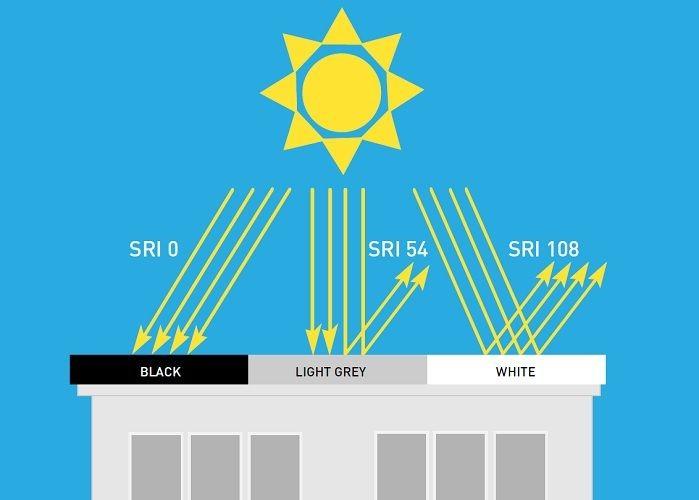
Solar reflectance (or albedo) is the ability of a surface material to reflect sunlight (solar energy) back into the atmosphere rather than absorbing it as heat. In traditional urban environments, dark surfaces like standard asphalt shingles and blacktop roads absorb up to 90% of the sun’s energy, radiating that heat back into our homes and streets long after the sun goes down.
How it Drives Our Goals:
Cool Roof Technology: By advocating for “Cool Roofs”—roofing systems designed with high solar reflectance—we can lower the surface temperature of buildings by up to 50°F during peak summer months.
Protecting Public Health: By reflecting energy away at the source, we reduce the ambient air temperature in densely populated neighborhoods, significantly lowering the risk of heat-related illnesses for vulnerable populations.